

To settle an estate, you must gather the deceased's assets, pay valid debts and taxes, then distribute what's left according to the will or state law. The formal process typically falls to an executor, administrator, or personal representative named in the will or appointed by a court. Before anything else, take three immediate steps: locate and file the original will, secure the home and any safe-deposit boxes, and order multiple certified death certificates.
TL;DR:
- Assets with designated beneficiaries or held jointly typically avoid probate, potentially shortening estate settlement to a few months for straightforward cases.
- Executors must open a separate estate bank account immediately after gaining authority and keep detailed records to avoid personal liability.
- The creditor notification window, usually lasting several months, must close before final distributions to prevent legal issues.
- Tax filings include the final personal income tax return and possibly estate income tax forms if the estate earns over $600; state-specific rules vary.
- Handling complex estates or contested wills usually requires legal assistance, especially when multiple states or high-value assets are involved.
Table of Contents
- What Are the Steps to Settle an Estate?
- What Does an Executor Actually Do?
- Do You Need Probate, or Can You Skip It?
- How Do You Inventory and Protect Estate Assets?
- How Long Does It Take to Notify Creditors and Close an Estate?
- What Tax Filings Does an Executor Need to Handle?
- Can You Settle an Estate Without a Lawyer?
- How Can a Life Map Help You Track Executor Tasks?
- What Happens When Debts Exceed the Estate's Value?
- What Mistakes Do Executors Commonly Make?
- How Do You Formally Close an Estate With the Court?
- A Few Honest Words on Getting Through This
- An Organized Way to Track What Still Needs Doing
- Where to Verify State-Specific Rules
- Sources
- FAQ
What Are the Steps to Settle an Estate?
Every estate follows roughly the same sequence, even though timelines shift depending on complexity and state law.
- Find the original will and file it with the local probate court, even if you think probate won't be necessary. Failing to file it can create title problems years later.
- Secure the home, vehicles, and valuables, and order multiple certified death certificates from vital records.
- Open a dedicated estate bank account as soon as you have legal authority, and never mix estate money with your own.
- Inventory every asset, from bank accounts to furniture, and schedule appraisals for real estate, vehicles, and anything of significant value.
- Notify beneficiaries, known creditors, Social Security, and any pension or insurance providers.
- Determine whether probate is legally required, and if so, file the petition to open the case.
- Pay verified debts and taxes first, then distribute remaining assets and collect signed releases from each beneficiary.
Pro Tip: Keep a simple running log from day one, dated entries, who you contacted, what they said. It becomes your best defense if a beneficiary later questions a decision.
What Does an Executor Actually Do?
The executor (sometimes called an administrator or personal representative if there's no will) is the person legally responsible for winding down the estate. Courts formalize this role by issuing Letters Testamentary, the document that lets you access accounts, sell property, and act on the estate's behalf.
This is a fiduciary role, meaning you're legally bound to act in the estate's and beneficiaries' interest, not your own. That means paying legitimate creditors and taxes before handing out any inheritance, no matter how much pressure family members apply.
Recordkeeping isn't optional. Executors who skip a dedicated estate account and commingle funds expose themselves to personal liability if the numbers don't add up later.
- Open a separate estate bank account immediately after receiving authority.
- Keep every receipt, invoice, and bank statement in one place.
- Log every payment and distribution with dates and reasons.
- Never pay a beneficiary before creditors and taxes are settled.
The most common executor mistake isn't fraud. It's distributing assets too early, then discovering a creditor claim or tax bill the estate can no longer cover.
Do You Need Probate, or Can You Skip It?
Not every asset goes through probate, and knowing the difference saves months of unnecessary paperwork.
Assets that typically bypass probate entirely include:
- Accounts with named beneficiaries, such as retirement accounts and life insurance policies.
- Property held in joint tenancy with right of survivorship.
- Assets already placed in a living trust.
- Payable-on-death or transfer-on-death bank and brokerage accounts.
If most of the estate's value falls into these categories, you may never need to open a full probate case. Many states also offer small-estate affidavits for estates under a certain dollar threshold, letting you transfer assets with a simplified sworn statement instead of a court proceeding. Those thresholds vary widely by state, so check your local probate court's website or a state extension guide before assuming you qualify.
Probate becomes unavoidable when the estate holds real property solely in the decedent's name, includes assets in multiple states, or faces a contested will. In those cases, skip the shortcuts and file the petition.
How Do You Inventory and Protect Estate Assets?
Start by pulling bank and brokerage statements, tax returns, and insurance policies. Check safe-deposit boxes, home files, and email for account records you might otherwise miss. If a bank or institution won't release information without formal authority, you may need to petition the court for Letters Testamentary before they'll cooperate.
Formal appraisals matter most for real estate, business interests, and valuables like jewelry, art, or antiques, since these figures affect both the final tax return and how fairly assets get divided.
Don't overlook digital assets:
- Email and cloud storage accounts.
- Social media and subscription services.
- Cryptocurrency wallets and exchange accounts.
- Password managers, which often hold the keys to everything else.
How Long Does It Take to Notify Creditors and Close an Estate?
Most states require executors to formally notify known and potential creditors, either directly or through published notice, once probate opens. This step is what actually controls how long settlement takes. States typically impose a mandatory waiting period, typically a few months, during which creditors can file claims against the estate.
You cannot legally make final distributions until that window closes. That's true even if you're confident no one will file a claim.
The good news: plenty of work can happen in parallel while the clock runs.
- Order appraisals and finalize the asset inventory.
- Prepare the decedent's final tax return.
- Sell property that needs to be liquidated anyway.
- Communicate with beneficiaries about the expected timeline.
A simple estate with a cooperative family and no real estate can often close within several months. A contested will, out-of-state property, or a business interest can stretch settlement past a year, sometimes considerably longer.
What Tax Filings Does an Executor Need to Handle?
Every executor needs to file the decedent's final personal income tax return, covering income earned up to the date of death. If the estate itself earns income during administration, such as interest or rental income, over $600, you'll need to obtain an EIN and file Form 1041 for the estate.
Federal estate tax only applies to a small fraction of estates, those above the exemption threshold set by the IRS each year, so most families never touch Form 706. State-level estate or inheritance taxes are a different story: rules and exemption amounts vary considerably, so check your state revenue department directly rather than assuming federal rules apply.
- File the decedent's final Form 1040 by the standard deadline.
- Get an EIN for the estate before opening the estate bank account.
- File Form 1041 only if estate income exceeds $600.
- Confirm state-specific estate or inheritance tax rules separately.
Can You Settle an Estate Without a Lawyer?
For small, uncomplicated estates with a clear will and cooperative beneficiaries, many people handle settlement without hiring an attorney. Small-estate affidavits and simplified probate procedures exist specifically for these cases.
Hire an attorney when the will is contested, real estate spans multiple states, the estate includes a business, or the tax picture gets complicated. Attorney fees typically come structured as a flat fee, an hourly rate, or a percentage of the estate, and they're usually paid from estate funds rather than out of your own pocket.
- Simple estates: often manageable solo with state-provided forms.
- Contested or multi-state estates: hire an attorney early.
- Complex tax situations: a CPA may be all you need, not a full estate attorney.
Pro Tip: Ask any attorney for their fee structure in writing before you hire them. A flat fee on a modest estate can cost far less than an hourly rate that adds up during delays.
How Can a Life Map Help You Track Executor Tasks?
Most of the stress in settling an estate comes from not knowing what you don't know, which accounts exist, which bills are autopaying, which subscriptions need canceling. One approach addresses that by mapping out the accounts, contacts, and documents connected to the deceased in one organized view.
- See every account and relationship that needs investigation, instead of guessing what might exist.
- Track which tasks are done, pending, or can wait, reducing the risk of a missed account surfacing months later.
- Keep a documented record of decisions and follow-ups for your own protection as executor.
This kind of service doesn't file claims or contact companies on your behalf. It keeps you in control of every call and letter. A typical first month might look like: week one, build the Life Map and secure documents; week two, notify agencies and open the estate account; weeks three and four, work through creditor notifications and appraisals.
What Happens When Debts Exceed the Estate's Value?
An estate is insolvent when total debts exceed total assets, and this changes the entire settlement process. Beneficiaries generally aren't personally responsible for the deceased's debts; the estate itself absorbs the shortfall, not the family's own bank accounts.
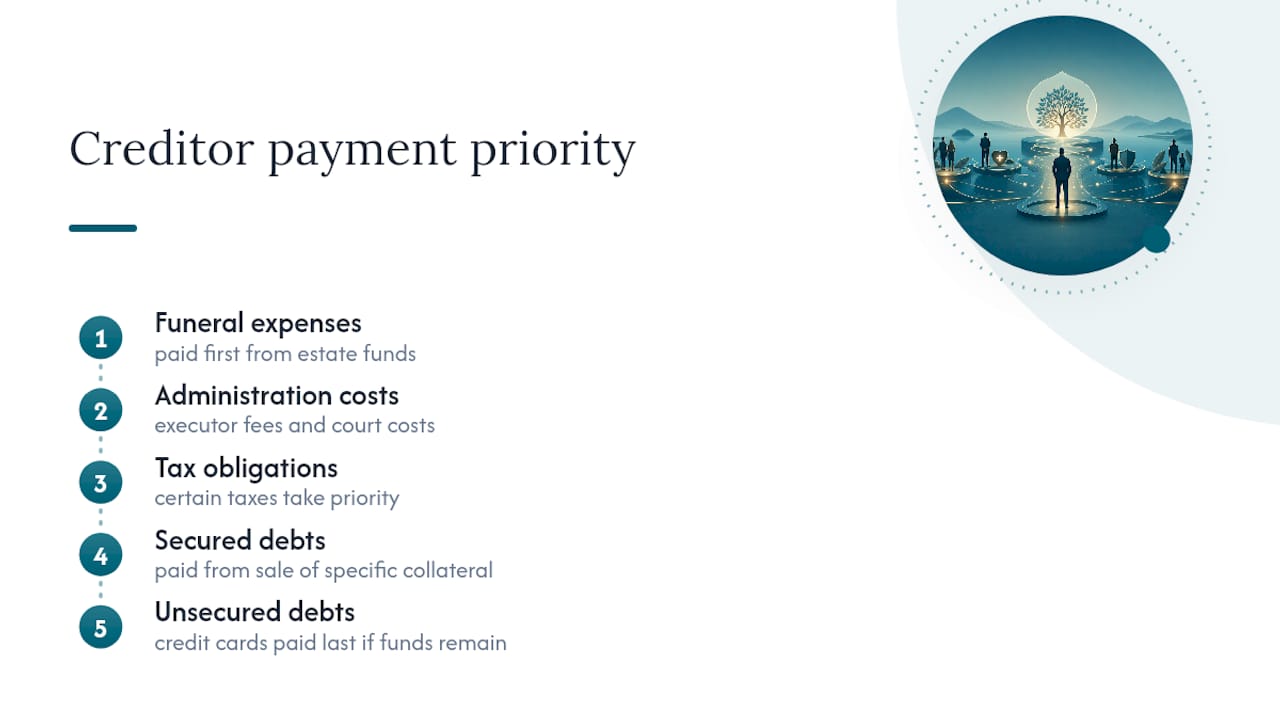
State law sets a specific order for paying creditors when funds run short, and it's rarely first-come, first-served. Funeral expenses, administration costs, and certain tax obligations typically take priority over unsecured debts like credit cards. Secured debts, such as a mortgage or car loan, get paid from the sale of that specific collateral before unsecured creditors see anything.
Do not start paying creditors out of order on your own judgment. If you suspect insolvency, pause and consult the probate court or an attorney before making any payments. Paying the wrong creditor first, even with good intentions, can leave you personally liable if a higher-priority creditor later goes unpaid.
Some states also allow a formal insolvency proceeding, similar to bankruptcy, where the court supervises exactly how limited funds get distributed. This protects you as executor because every payment happens under court approval rather than your own discretion. Document every creditor claim you receive, valid or not, and keep copies of your correspondence explaining why any claim was rejected. If a creditor disputes your decision, that paper trail is what protects the estate and you personally from a later lawsuit.
What Mistakes Do Executors Commonly Make?
The single biggest mistake is distributing assets before the creditor window closes. It feels compassionate to get money to grieving family members quickly, but if a valid claim surfaces afterward and the funds are gone, you may be personally on the hook for the shortfall.
Commingling funds ranks a close second. Depositing an inheritance check into your personal account, even temporarily, blurs the line between estate and personal money and makes every subsequent transaction harder to defend if questioned.
Executors also frequently underestimate how much family conflict slows things down compared to legal complexity. A contested will or a sibling who disputes an appraisal can add months or years to a case that would otherwise wrap up in under a year.
Other recurring errors:
- Missing tax deadlines because no one tracked the decedent's final return.
- Failing to get formal appraisals, leading to disputes over asset values later.
- Ignoring digital accounts and subscriptions until they've racked up charges.
- Skipping the will-filing step because probate seemed unnecessary.
The fix for nearly all of these is the same: organize documentation early and resist the urge to move fast on distributions. Speed feels helpful in the moment. A missed step almost always costs more time later than it saves upfront.
How Do You Formally Close an Estate With the Court?
Closing the estate is the final administrative step, and skipping it leaves your legal responsibility technically open even after you've distributed everything.
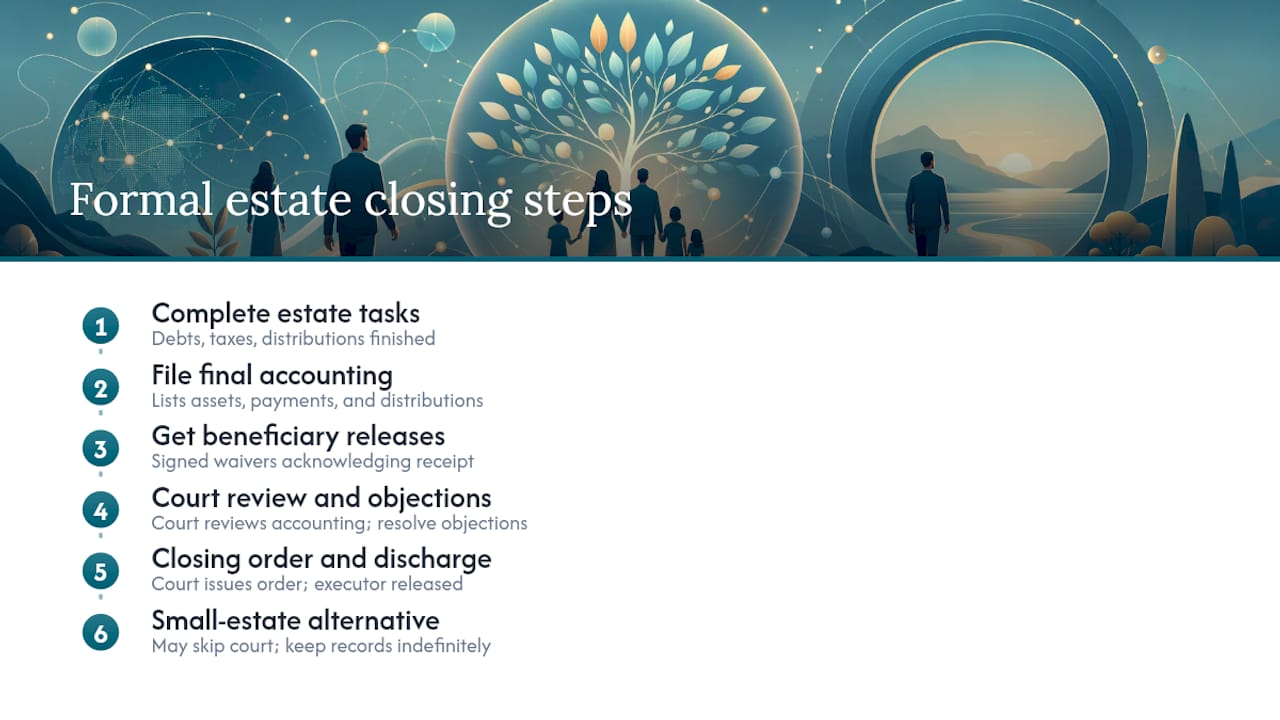
Once debts, taxes, and distributions are complete, you'll typically file a final accounting with the probate court. This document lists every asset the estate held, every payment made, and every distribution to beneficiaries, essentially the ledger you've been keeping since day one made official.
Beneficiaries usually need to sign releases or waivers acknowledging they received their share and won't contest the accounting later. Courts often require these signed releases before approving the final closing petition.
After the court reviews the accounting and any objections are resolved, it issues an order formally closing the estate and discharging you from your fiduciary duties. This matters more than it sounds: until that discharge happens, you technically remain liable for the estate's affairs.
Some simplified or small-estate procedures skip formal court closing altogether, particularly when no probate case was opened. In those situations, your obligation typically ends once you've distributed assets and kept records showing you followed your state's small-estate rules correctly.
Whichever path applies, keep copies of the final accounting, signed releases, and the closing order indefinitely. If a question ever comes up years later about how the estate was handled, that folder is the only thing standing between you and a difficult conversation.
A Few Honest Words on Getting Through This
Grief doesn't pause for paperwork, and the weight of being responsible for someone else's affairs while mourning them is real. Take it one task at a time. Nobody expects you to know probate law by instinct, and asking for help on the complicated parts isn't failure, it's good judgment. A clear checklist won't make the loss easier, but it can make the process less frightening.
— Xavier
An Organized Way to Track What Still Needs Doing
There are platforms that give you a private, structured way to see every account, contact, and document tied to a loved one's estate, without ever filing a claim or making a call on your behalf. That distinction matters: you stay in full control of every conversation with a bank, a creditor, or a beneficiary, while the platform simply keeps track of what's been handled and what's still open.

Instead of juggling sticky notes and half-remembered account numbers, you build a Life Map once and work through it at your own pace. It pairs naturally with the checklist above, especially the financial accounts and payments that tend to slip through the cracks. If you're ready to stop carrying the whole inventory in your head, start organizing your estate's accounts and tasks with Griefwreck's toolkit.
Where to Verify State-Specific Rules
Probate thresholds, tax deadlines, and filing requirements vary by state, so treat this article as a starting framework, not a substitute for checking local rules. The IRS publishes current federal filing requirements and thresholds, while your state's probate court or department of revenue can confirm small-estate limits and any state inheritance tax that applies to your case.
Sources
- Settling an Estate — SevenPonds
- How to settle an estate | Nolo
- Responsibilities of an estate administrator — IRS
- How long does probate take — Afterkin
- Understanding the estate bank account — KSMO Probate
FAQ
What Does It Mean to Settle an Estate?
Settling an estate means formally collecting the deceased's assets, paying legitimate debts and taxes, and distributing what remains to heirs or beneficiaries according to the will or state law.
How Much Does It Usually Cost to Settle an Estate?
Costs vary widely depending on whether you hire an attorney and how complex the estate is; attorney fees are typically structured as a flat fee, hourly rate, or percentage of the estate, and are usually paid from estate funds rather than the executor's own money.
Can an Estate Be Settled Without a Lawyer?
Yes, many smaller or straightforward estates are settled without an attorney using small-estate affidavits or simplified probate procedures, though rules vary significantly by state.
How Long Do You Have to Settle an Estate After Someone Dies?
Most states impose a creditor waiting period of three to six months before final distribution, meaning simple estates often close in six to nine months while contested or complex estates can take a year or more.